Zeno's Paradox
Philosophy is contemplating puzzles about existence. An example is Zeno’s paradoxes, which I think remains unsolved and important to solve. Here’s why.
The first definition in Euclid’s Element’s is:
A point is that which has no part.
There follows a series of definitions, including of a line, surface, boundary, figure, and the final, 23rd, definition is:
Parallel straight lines are straight lines which, being in the same place and being produced indefinitely in both directions, do not meet one another in either direction.
Euclid also sets out 5 “common notions”, including:
4. Things which coincide with one another are equal to one another.
5. The whole is greater than the part.
So geometry, which was to dominate mathematics until the time of the Cartesian plane and Newton and Leibniz’s calculus, relies, at least to some extent, on the assumption of the existence of the infinitesimal, the infinite, the notion of identity, and the notion of the existence of parts which make up wholes.
Mathematicians, philosophers and, more generally, people going about their day-to-day lives were, and remain, in the habit of helping themselves to concepts that are actually very difficult to explain.
Parmenides’ poem and Zeno’s paradoxes show that there is something odd about certain concepts and prompt us to reflect on the nature these concepts and how we use them. For example, Zeno’s tortoise/Achilles paradox plays on the idea that an infinite number of tasks would need to be completed in a finite time and that this is impossible. Post-calculus and the understanding of infinite series, we can model the completion of an infinite number of tasks in a finite amount of time. E.g. ½ + ¼ + 1/8 + 1/16 + … is a series that converges asymptotically to 1, a finite number. So we have a powerful tool to describe the problem and may think that we understand what is going on. Some have argued that this means we have solved the problem. If mathematics is an abstracted description of what’s going on in the world, or if we somehow construct physical extensions out of mathematical items, then the paradox may be solved. However, calculus has not necessarily solved the problem that Zeno raises unless it actually describes reality.
Consider the arrow-in-flight-yet-at-rest paradox, which tries to show that the moving arrow is always at rest by suggesting that at any instance in its journey the arrow occupies an arrow shaped/sized part of space and is not moving (because there is not enough time for movement, as is stipulated). I.e. since time = 0 and distance = 0, we must conclude that speed = 0.
A possible and common response to this particular paradox is to claim that algebra and calculus resolves the problem:
A cartesian plane means that we can turn geometrical, space-based problems like the one above into algebraic ones. Points (as per Euclid’s definition) have an ‘address’ on an x- and y-axis and all the points on a particular line obey the equation that describes that line. You can manipulate the equation to give information about a range of things e.g. location of intersection. So we can plot out the trajectory of a moving item and analyse what is happening at each stage. Calculus allows us to describe change by talking about very small increments and by approximating, e.g. looking at points on a Cartesian plane that are close to one another and letting them ‘drift’ closer to one another until the gap ‘vanishes’. Calculus tells us that speed can be modelled by taking time intervals over smaller and smaller periods e.g. average speed of x over 1 second, y over half a second, z over a quarter of a second, and noticing that x, y and z tend towards a certain limit. This limit is the speed according to calculus.
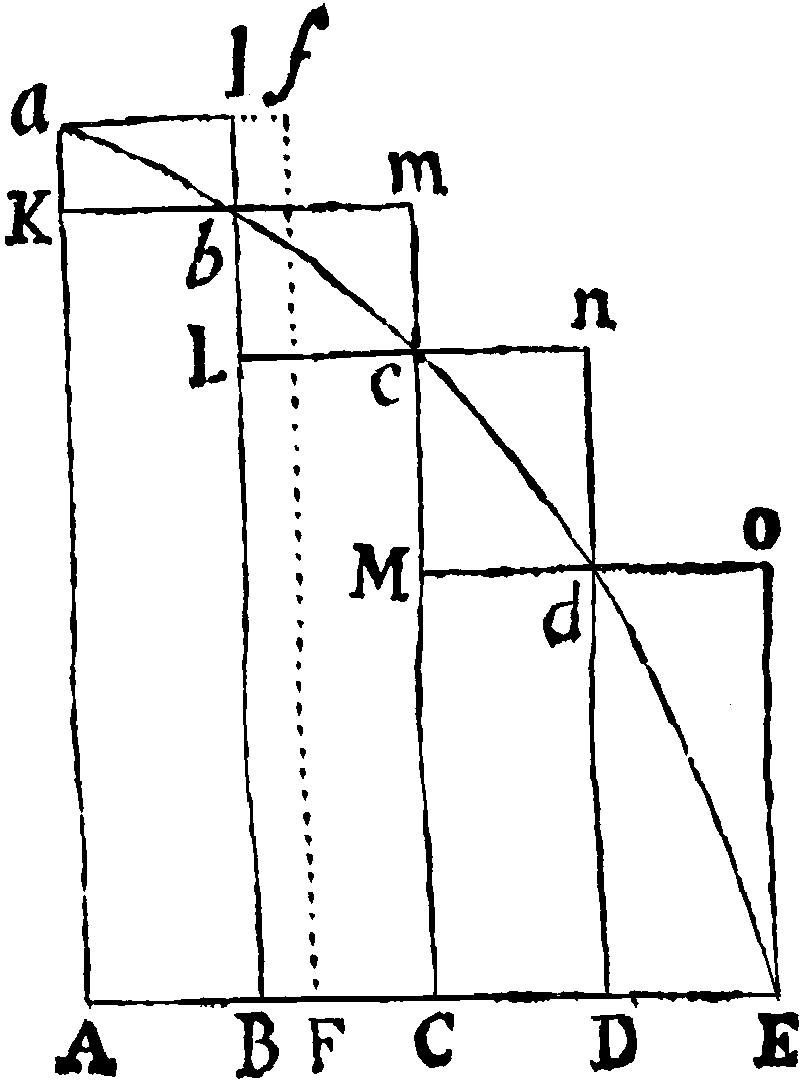
In Newton’s Principia (Book 1 Section 1) we find the following description:
Lemma III: Eædem rationes ultimæ sunt etiam æqualitatis, ubi parallelogrammorum latitudines AB, BC, CD, &c. sunt inæquales, & omnes minuuntur in infinitum.
…
Corol. 1. Hinc summa ultima parallelogrammorum evanescentium coincidit omni ex parte cum figura curvilinea.
Corol. 2. Et multo magis figura rectilinea, quæ chordis evanescentium arcuum ab, bc, cd, &c. comprehenditur, coincidit ultimo cum figura curvilinea.
‘Evanescentium’ is used a further eight times in the text and is translated as ‘vanish’ or ‘disappear’ as though Newton can simply dissolve, by sheer will, any remaining space between points until it fades to nothingness.
Initially it looks as though we can now describe and understand the world of change, but we have arguably cheated because we have assumed upfront that the thing we are modelling is moving, and we cannot simply help ourselves to that fact. We still have not answered when and how the thing is moving, Zeno’s challenge. Calculus allows us to describe the world using the concept of motion within certain domains, but we have not yet understood the concept.
An alternative response to this paradox is to challenge the assumption that duration is made up of a series of ‘nows’ or that extension is made up of a series of infinitesimal, property-less points. It is one thing to take a particular example of duration or extension and then to select a part of it (a ‘now’ or a point), but quite another to take a collection of ‘nows’ or points and then try to construct a duration or extension simply by adding them all up.
This objection is far more effective. Concatenation of property-less points may not be able to explain how we end up with extensions, i.e. objects, with properties that we see all around us.