Life value-drivers

In this series I’ll consider tasks and techniques used to good effect in business that can be adapted to be useful in broader life. In the first of this series, I’ll repurpose a profit and loss model for choosing which actions to focus on to make progress achieving one’s life goals, whether it’s to become well-read, to circumnavigate the globe, to foster deeper connections with friends, or any other goal.
Why this model matters
Using this model means that, when considering questions like ‘what should I do today?’, ‘how should I act in this situation?’, ‘what should I devote the next hour of my life to?’, ‘what reaction is most helpful now?’, the answer will be clear:
Do what will be most impactful. Do what will drive most success (however you have defined success for you). Do what will mitigate the biggest risk. Do not do some tangential action and be left wondering why it is ineffective. Do not waste time worrying or attempting the impossible.
The model will guide you to take purposeful action to maximise your success given the goal you have chosen to pursue and the circumstances you find yourself in. It sets you up for success.
Seeing the original in action
In business, profit and loss health is one’s primary goal. And in order to maximise profit and minimise loss, one should begin by mapping out what I’ll be calling the ‘value-drivers’ of the business. Then identify those value-drivers that have the biggest impact on the P&L and target resource-allocation (time, efforts, attention, money) accordingly, only taking action on the big ticket items. Here’s the stages in full detail followed by the means of adapting this quantitative business tool to qualitative life goals.
First, consider all the things that drive success or failure, the value-drivers, in the context of a particular business. The list will eventually include secured income (100% probability of +£x), opportunities if certain events transpire (0-100% probability of £x), costs (100% probability of -£x) and risks (0-100% probability of -£x). In the first phase, start by breaking down the goal into its component parts. For example, if my business involves buying some product at one location then moving it to sell at another, storing it in the meantime, then my goal is impacted by these component parts: the price I can buy the product for, the cost of moving it, the cost of storing it, and the price I manage to sell for. Next, consider each of these four in turn, and ask what impacts the value proposition at each stage. There will be a set of drivers that impact the price I can buy the product for, and different sets of drivers that impact the cost of transport, the cost of storage and the price I can sell for. For example, if I buy strawberries in Norwich to sell at Wimbledon, then the cost of buying them might be impacted by weather or worker availability, the cost of transport might be impacted by petrol prices or lorry shortages, the cost of storage might be impacted by the cost of electricity to run refrigeration units, and the price I can sell for might be impacted by local supermarket pricing. After drawing up a full list of the many value-drivers, consider each of these again, in turn, asking ‘and what drives that?’ until hitting bedrock: the ultimate value-drivers, both positive and negative, both guaranteed and possible, that affect the extent to which the end goal will be achieved.
An incomplete, illustrative example:
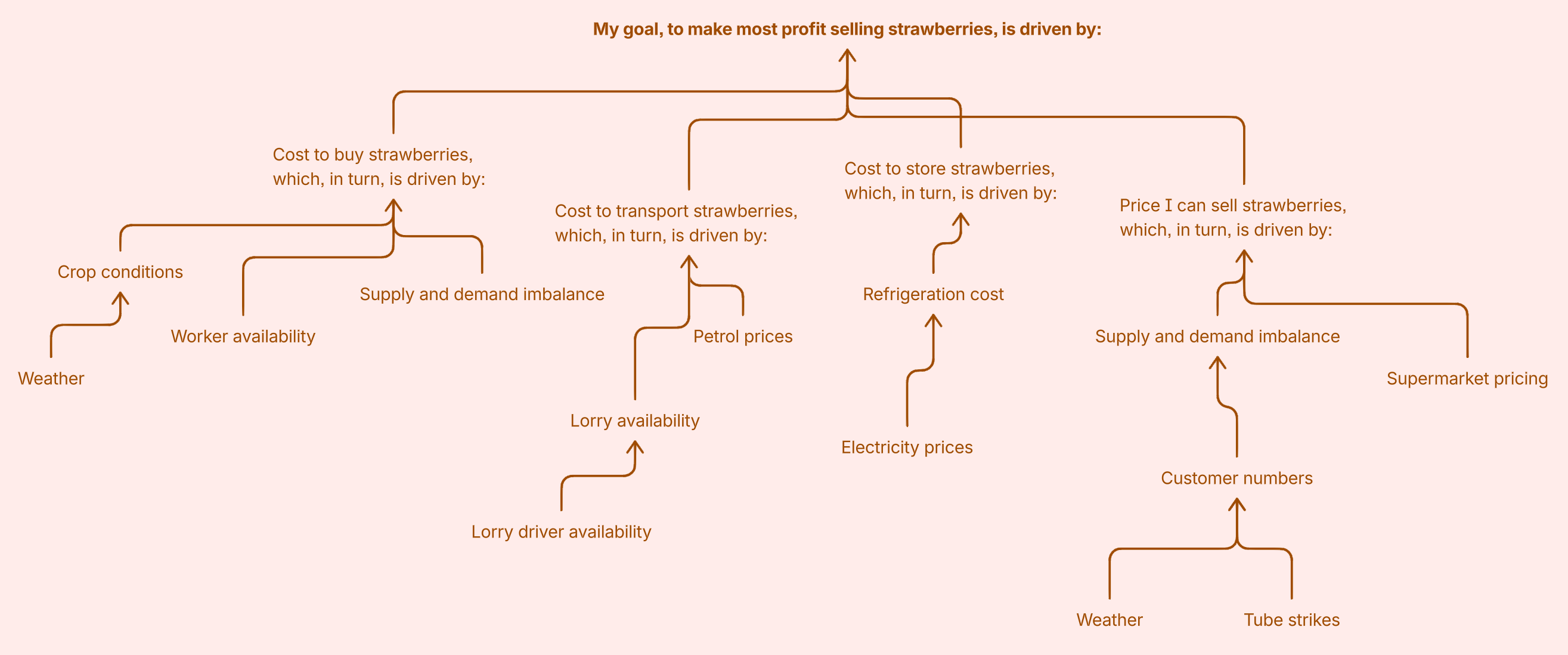
The ‘ultimate value-drivers’ are all those items found on the bottom row. When the exercise is complete, the bottom row is nothing short of a complete list of all of the things that ultimately drive the goal written on the very top row.
Second, for each items on the list of ultimate value-drivers, estimate the £-value impact each could have on the business (whether it’s positive or negative) and the probability of occurrence. Multiplying these figures allows creation of an ordered list: biggest value-driver first down to smallest value-driver last. This will be a long list, but it will be immediately clear that only some items are significant value-drivers, while the rest are likely to impact goal-attainment only a little. One item may be 1000x more impactful on the final P&L ledger than another.
Finally, with a list of ultimate value-drivers at hand, one can select a subset of those most likely to have the biggest impact on the goal of maximising profit and minimising loss, and make a judgement call on which value-drivers to focus resources on to mitigate risk and capitalise on opportunities. Used well, this stops one from spending excessive or disproportionate time and money to mitigate a risk that never posed a significant threat, and to instead redirect that time and money to mitigate a risk that could be much more impactful. It will allow targeted use of resources to go after the biggest opportunities only, giving them the focused attention they deserve to get them over the line and secure profit. For each of the ultimate value-drivers that you select to focus on, ask:
‘What, if anything, can I do to boost the positive impact this value-drive has on my goal or dampen the negative impact this value-drive has on my goal?’
‘If this opportunity or risk were to arise, what mitigations should I be ready with, and what can I do now to prepare?’
Then do these things and only these things.
How to make the model your own
In life, one can also follow this model. First, be clear on what the goal is, as this will not be as simple as in business. It might be a big goal or a small goal. Let’s take something like ‘become well-read’ as an example. Consider what would drive success or failure, for instance, having access to books, having time to read them, etc. Then consider what impacts those things, such as budget, whether it’s possible to carry heavy books while commuting, work hours, etc. until the ultimate value-drivers are reached. These will vary for different people in different circumstances, and only asking ‘and what drives that?’, ‘and what impacts that?’ repeatedly will it be possible to know the ultimate causal factors, the things driving progress or struggles with goal-attainment.
An incomplete, illustrative example:
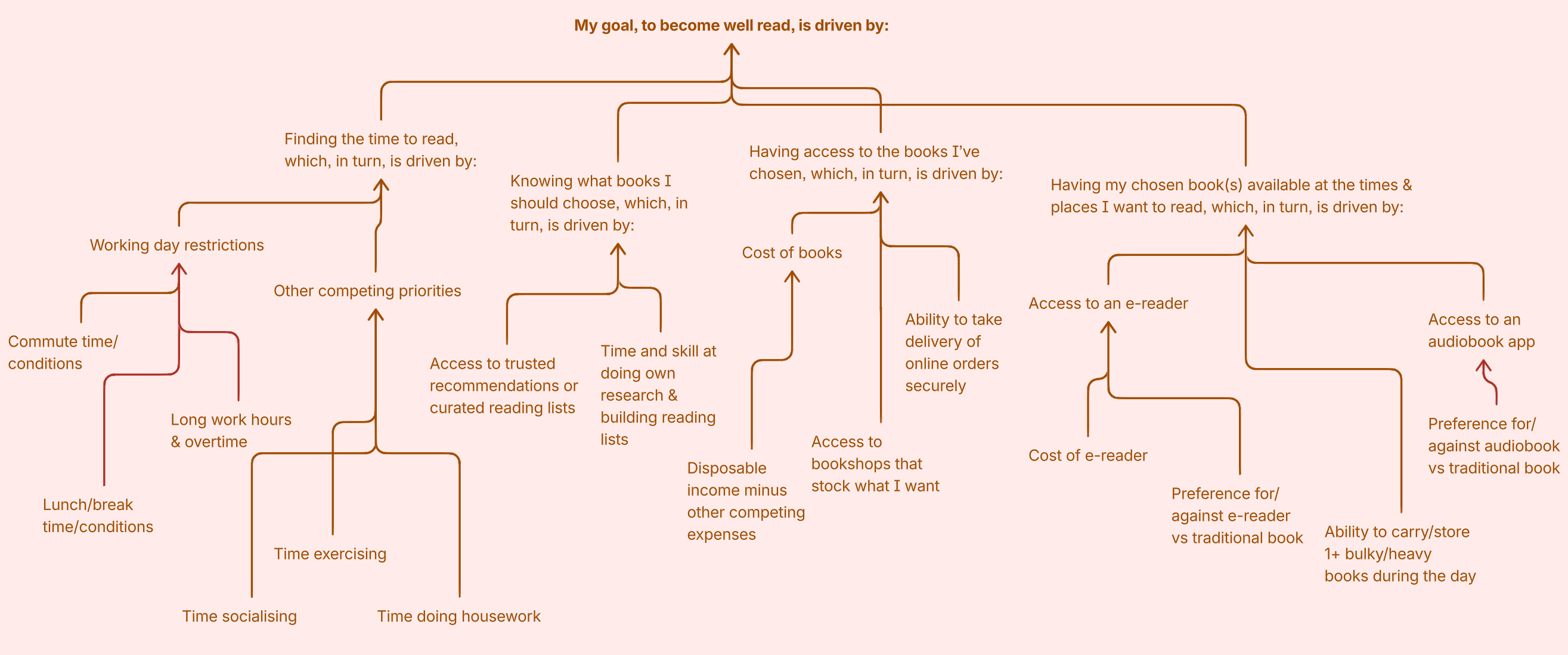
One should then take time to reflect and understand what has the biggest impact on goal-attainment by assigning relative weightings and then, as per the model above, combining magnitude of impact by probability of occurrence for each value-driver. This will be a judgement call and estimation in some cases, but can be refined and updated over time. Then, use an impact-ordered list to chose what to focus attention on retaining, developing or adjusting.
If the goal is simple then the list of factors driving success or failure might be short, but it is still worth writing down in order to fully appreciate what is driving progress or struggles - the process is likely to unearth previously overlooked factors. When ‘complete’, revisit in 1 week for another 30 minutes because it is likely some further factors will emerge subconsciously after kicking-off this exercise and after ruminating on potential untapped opportunities or previously tricky dilemmas. If the goal is complex, ‘solve Russell’s paradox’, ‘be on one of the early manned missions to Mars’, ‘achieve equanimity’, the list may be lengthy. In life, it is not unusual to have more than a single goal, therefore multiple lists should be developed and then considered side-by-side.
What you stand to gain
Having undertaken this exercise, when considering questions like ‘what is my plan for today?’ ‘what is the risk my plan is derailed?’ ‘how can I get back on track?’ ‘am I prioritising what I should be?’, the answer will be clear. You can see which levers you can pull to improve your chance of achieving your goal, and you can identify what might hinder you and to what extent. You are therefore in a position to take (only) actions that will progress goal-attainment (and nothing else) - note this will be fulfilling only if goal-setting has been done well.
Part of the process will be acknowledging which factors are not in one’s control and considering what controllable levers are available to pull in response. For example, the strawberry seller knows the weather will impact both supply and demand for strawberries. The seller cannot control the weather but, by understanding where weather and other drivers feature in their model, they can see what can be done if poor weather conditions arise and whether or not it should be done (if the risk is significant enough). Instead of being unprepared, fretting or unsure of how to proceed, they will already have made a deliberate decision either to ignore weather-related risk (if it is likely to have only a small impact on their business) or to take certain actions to mitigate the risk (they may have chosen to purchase insurance or more storage just in case, or may have researched alternative locations to buy or sell if the need were to arise).
When using this model, you do not waste time worrying or attempting the impossible. You set aside what is out of your control and you are in a position to immediately take purposeful action to maximise your success under the circumstances you find yourself in.
When using this model, when you act, you know that you will be maximally effective at bringing about your desired outcome, because your action has been selected for that purpose, and you can do it calmly and deliberately. That is all anyone can ever do.